by Paul Martin
Prince. Tom Petty. Mac Miller. Now Hayden Panettiere. And last week, Cindy Crawford’s 27-year-old son, Presley Gerber, died in what police are investigating as a suspected overdose.
Their deaths are tragic. Because unlike grief that follows an expected fatality, traumatic grief is different. It follows an event such as a death that is sudden, unexpected, or violent. The shock leaves survivors processing both the event itself and the trauma of how it happened, intensifying feelings of disbelief, fear, anger, and helplessness. The sudden death of a child can be particularly devastating because there is no opportunity to prepare or say goodbye.
The families of Hayden Panettiere and Presley Gerber deserve every ounce of sympathy they receive.
But there is something about the attention that troubles me.
Approximately five hundred thousand Americans have been poisoned in the last decade by fentanyl. That means one million parents grieve the loss of their child. Add siblings and grandparents, it’s over five million.
Most of their names never made a headline.
I’ve spoken with and read the emails from thousands who grieve today, mostly mothers. I know what their pain sounds like.
Those I know and represent are not millionaires or celebs. They weren’t invited to the Oscars or the Super Bowl or the Met Gala. Few had social media followers in the six digits.
Though America doesn’t know their names, that doesn’t make them less human, nor their deaths less tragic.
These young lives were snuffed out by a drug crisis so vast in scope and scale that it’s hard for most to comprehend. Consider that 58,220 Americans died during nearly 20 years of the Vietnam War. Fentanyl has killed 500,000 Americans in roughly half that time. And no minor children died in Vietnam while thousands have been poisoned by fentanyl; hundreds were children under five.
And despite reports of recent reductions in annual fatalities, nonfatal overdoses are still on the rise. In some states deathsare on the rise. What this means is that reversal agents, such as naloxone, are more widely available to revive those in the process of overdose, and yet millions remain on the cliff.
I wish I could copy and paste the thousands of emails we’ve received from parents and grandparents (raising “fentanyl orphans”). Stories about loss of employment, financial ruin, lying in bed for years, even homelessness and suicide attempts. Here’s one from Christy in Pennsylvania:
“William helped support and pay my bills, fixed my car and repaired everything. I don’t own a car now and have no health insurance! He helped his siblings…paying for auto repairs and gas…He paid off $4,000 of his sister’s student debt so she could finish college…it’s shattered us all to pieces and crushed our souls.”
A study on the National Institutes of Health website called Bereavement Experiences After the Death of a Child underscores the difference between general stress and complicated grief, concluding that while “bereavement is stressful whenever it occurs, studies continue to provide evidence that the greatest stress, and often the most enduring one, occurs for parents who experience the death of a child.”
Those like Christy rarely cite the physiological causes driving their suffering; they talk about the effects on their emotions. Many don’t understand the changes in cortisol and other stress hormones, inflammatory signaling, sleep, and immune regulation.
Bottom line is they say the death destroyed their lives.
Yet many of them turn from despair to activism. Well before I launched UAF, these heroes were speaking and working for real change. Last weekend, hundreds, mostly mothers, came to Washington, D.C. to register their voices in our nation’s capital as part of UAF’s Washington Weekend.
From nearly 40 states they boarded airplanes for the first-ever coordinated fentanyl Hill Day on Capitol Hill, followed by Walk for Lives on The Mall the next day, then the first Summit on Synthetic Drugs at Georgetown University. Some created crowdfunding pages to get there. They sent countless letters letting their senators and House members know they were coming. And on the day, State Captains led delegations into the offices for scheduled meetings with elected officials and staffers. They are now back home sharing their work on social media. We will soon begin our next phase of policy outreach.
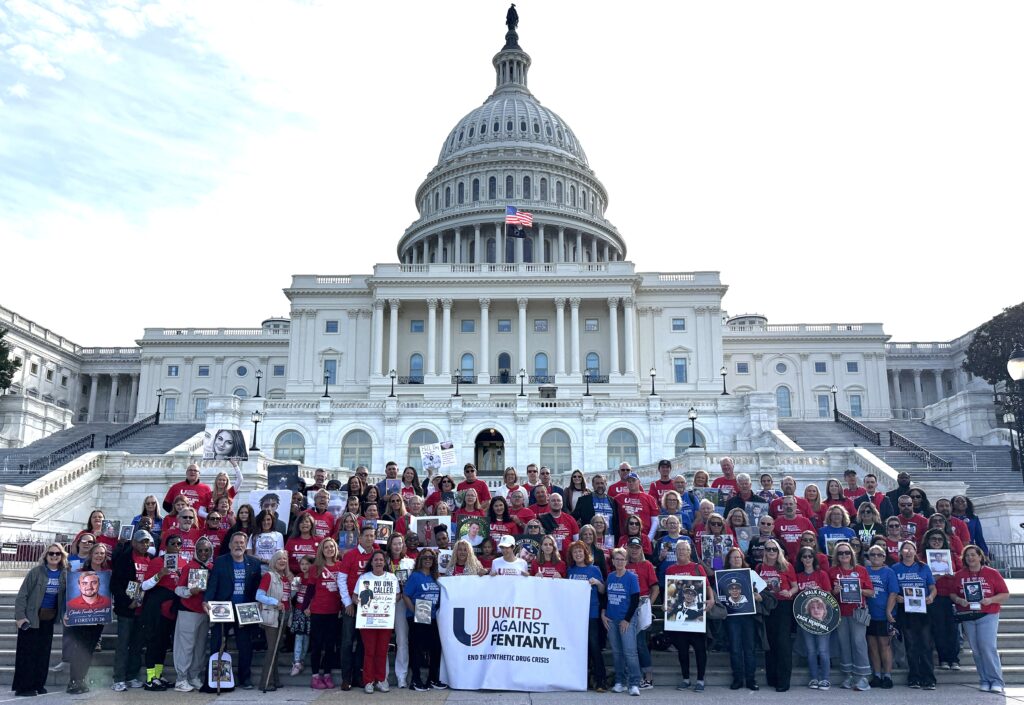
The events in Washington were part of our 2026 efforts. On July 11, 110 Walk for Lives events took place across the country, drawing close to 10,000 and generating hundreds of millions of digital impressions. Each event provided life-saving awareness, education, and resources in partnership with public health and law enforcement, including the Drug Enforcement Administration.
I’m being told by some that over the next five weeks they will lose sleep if necessary so candidates for the November general elections “say fentanyl” in their campaign speeches. These families are not asking candidates to agree with any policy; they are asking them to at least talk about it. They believe you can’t campaign on protecting American families without naming the thing that is killing America’s children.
Anyone can take just one minute, fill out this form at SayFentanyl.org and a letter will immediately be sent to your senators and House member asking them to talk about fentanyl in their speeches over the next five weeks. These letters matter, and one minute of your time is all it takes.
I have three adult children and am a proud and devoted father. For the life of me, I cannot comprehend why those in elected office and the mainstream media will not talk about the number one killer of young Americans. I know there are exceptions, but overall, the fentanyl crisis, in my view, has been put on the back burner. This is unacceptable.
My heart breaks for the parents who are celebrities as much as it does for others. I am not comparing the indescribable heartbreak of losing a child. As I’ve said hundreds of times to parents, “As a father of three adult children, I can only try to imagine, and that’s all.”
Nonetheless, it baffles me how the greatest killer of young Americans gets so little attention, unless the one who died is a celebrity.
But from the depths of my heart, I believe that, together, we can change that.


