By Paul Martin
You’re watching the game. You’re losing 10–0. Your team scores a goal. Some celebrate. For them, the celebration is justified: things are improving.
But you’re still losing. By a lot.
For three years, the news has reported that overdose and poisoning deaths are finally declining. And they are. Tens of thousands have been given a second chance. We should commend the paramedics, nonprofit organizations and their volunteers, government agencies, elected officials, and perhaps most of all, the bereaved family members who transformed unimaginable pain into gritty, unflinching purpose.
Amidst the celebration, there’s something few are talking about. In 2026, overdoses in the United States are at an all-time high. In the twelve months ending May 2026, Americans experienced overdoses at a rate of 195.7 per 100,000 people. In 2021—the year that became the grim benchmark of the pandemic’s toll—that rate was 183.5. (This analysis was first published by Madeline Hilliard of DopaGE on June 15, 2026.)
According to the National Emergency Medical Services Information System, more people’s bodies are shutting down from drug exposure right now than at any point in recorded history. What this means is simple: more overdoses, but fewer fatalities.
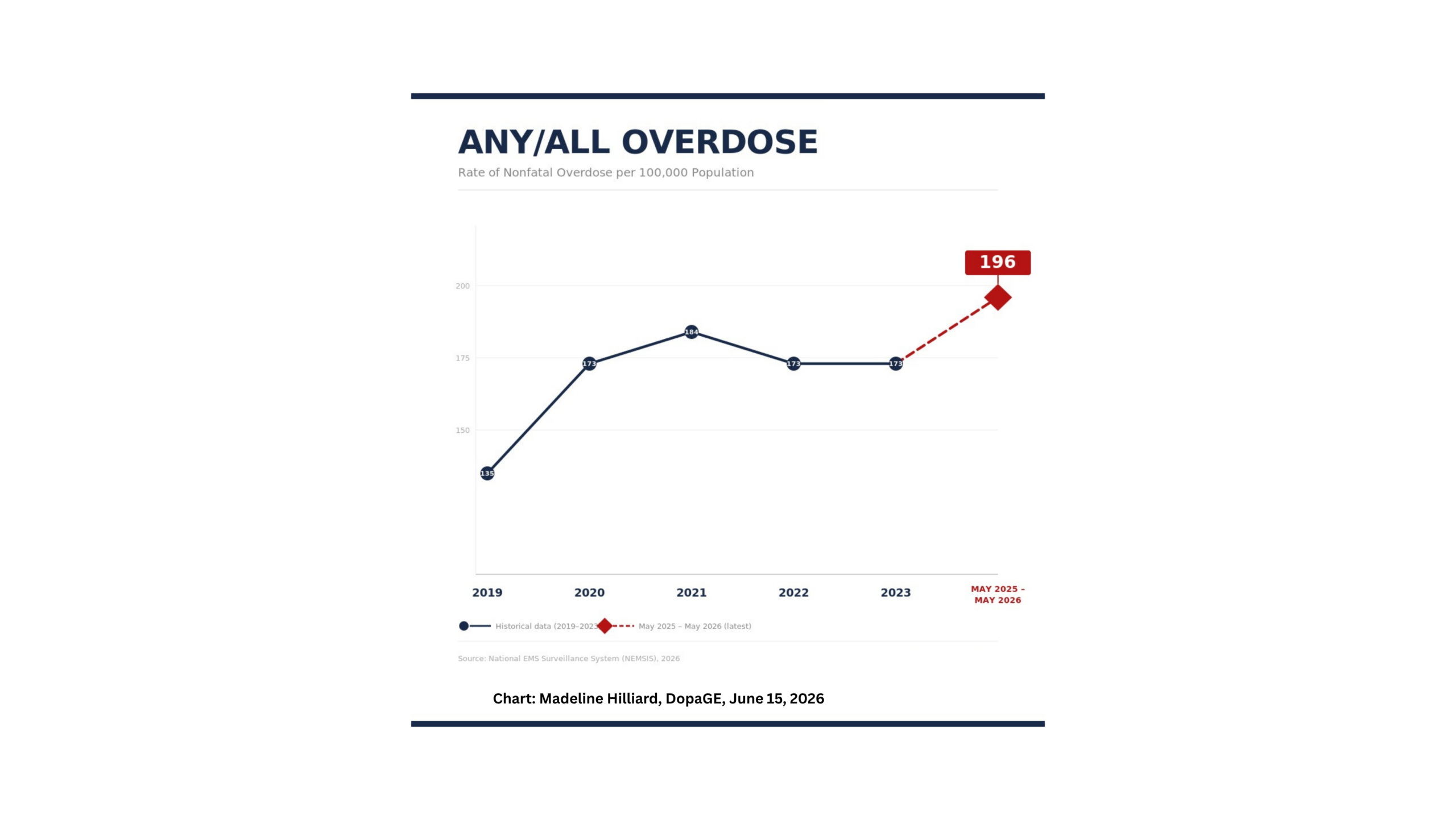
These numbers are telling us something precise, if we’re willing to listen.
Yes, the downstream rescue side of the problem is working. Naloxone is more accessible than it has ever been. Millions of doses are distributed every year through pharmacies, community organizations, health systems, and public health programs.
Those working in harm reduction deserve tremendous credit. My friend Theo Krzywicki, a paramedic who witnessed the fentanyl crisis firsthand in Los Angeles, founded End Overdose in 2018. Since then, the organization has distributed 750,000 naloxone kits and 250,000 test strips, and trained hundreds of thousands of people across the country, particularly on college campuses and at live music events. Countless other organizations, agencies, and individuals have also worked tirelessly to put life-saving naloxone into people’s hands.
Harm reduction measures have saved, and are saving, lives.
But there’s a problem.
If overdoses keep rising while deaths fall, it may feel that we’re winning, but we’re not. Yes, we’ve gotten better at catching people after they fall off the cliff. But we’ve done almost nothing to move them away from the edge.
And in many states, deaths aren’t falling at all—they’re rising. Arizona, Colorado, and New Mexico saw an increase in overdose deaths according to CDC data released in May 2026. So did countless cities and counties across the nation. That’s right, overdose deaths went up.
Nearly every day I speak with parents who have buried a child. I hear the same thing repeatedly—their children struggled with addiction and did not have access to treatment they so desperately needed.
Then there is the tragedy of those who did not struggle with addiction but died nonetheless. In 2024, 63 percent of accidental overdose deaths involved fentanyl. Among people ages 15 to 30, that figure was 78 percent. Many of those young people never intended to take an opioid. They accepted something from a friend or purchased what they believed was a legitimate medication. Usually they took the pill alone, and naloxone in these cases usually comes after it’s too late.
We have become so focused on what is measurable—mortality rates, EMS response times, naloxone distribution numbers—that we’ve grown numb to what doesn’t appear in the headlines.
Last month, I returned to the rural streets of Española, New Mexico, where I worked on the fentanyl crisis in 2023. What I saw was largely unchanged: people using, overdosing, being revived, and then using again.
The scoreboard doesn’t show the user who used yesterday and survived only because someone happened to be standing nearby with naloxone. It doesn’t show how close they came. It doesn’t show that so often the revived user will go right back to trying to quell the indescribable need to feel better again—to use.
We must continue to do all we can to distribute naloxone and save lives. But we need more.
We tell children about the dangers of smoking. We teach them about alcohol. And then, in 2026, we send them into a world where fentanyl can be pressed into any pill — a Xanax, an Adderall, a Percocet — and we give them almost nothing to prepare them for it. A single federal standard for drug education in every public school is not a radical idea. It is the minimum this moment demands.
In too many places in this country, it is genuinely easier to find a pill laced with fentanyl than it is to find a treatment bed. That is not a healthcare failure. That is a policy choice. We have chosen, repeatedly, to fund the rescue and not the recovery. Every pathway into treatment — hospitals, primary care, harm reduction programs, deflection programs that let police direct people toward care instead of cages — needs to be expanded now.
And treatment alone isn’t enough. Sobriety is not a moment. It is a decade of mornings. The people I know who are in recovery need housing, employment, people who have been where they have been and found their way out. Recovery coaches. High school and college recovery programs. A dedicated funding stream that tells someone in year four of their sobriety: this country still has your back.
Finally — and I will keep saying this until someone listens — China is the source. The precursor chemicals used to manufacture fentanyl flow from Chinese suppliers to Mexican cartels to American streets. The State Department should be at a table right now, negotiating a global synthetics treaty that puts real controls on that pipeline. (You can take just one minute to help pass the bipartisan Stop Chinese Fentanyl Act).
These are not radical proposals.
They are the naloxone of prevention and treatment: proven, scalable, and distributable.
We simply have not deployed them at the scale this crisis demands.
I am not immune to the pull of good news. After years of sitting with grief, you want something to hold onto. So does every family I know.
But declining death rates are not permission to declare victory over a crisis that, by many measures, remains deeply entrenched.
We scored a goal. It feels good.
We also need to read what the scoreboard says.
We are not winning.
Editor’s note, August 20, 2026: This article has been updated to credit the original analysis and chart to Madeline Hilliard of DopaGE


